Scythe Matters
Posted By Randy on August 26, 2012
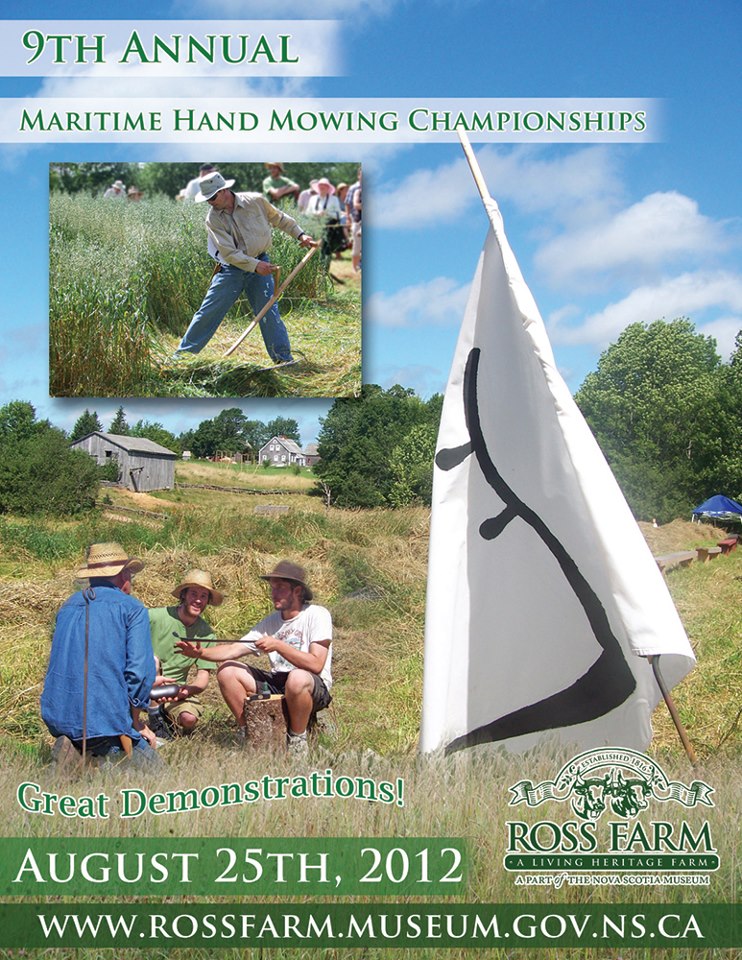
One of several banners promoting this year’s event that were created by the Ross Farm Living History Museum, and posted to their facebook page. Click the image to enlarge it.
I first mentioned the Maritime Hand Mowing Championships, hosted annually at the Ross Farm Living History Museum, last June in my article Musings of an Apprentice Mower. At the time I stated that Mrs. LFM and I would be attending what was then the 8th annual iteration of that splendid event, and soon after was reminded that the Gods laugh at him who dares speak his plans aloud. Not so this year, for we held our cards close to the vest, and successfully soaked in the 9th annual event yesterday!
Before continuing, and to save myself a lot of explaining, I’ll give you some insight by way of a highly informative video from the Ross Farm YouTube channel that speaks of last year’s competition …
If you’ve read my recent announcement of the Not All That Grand Opening of the LFM Shootin’ Range, you’ll know we’re well on the way to his and hers synchronized mowing, and while Mrs. LFM and I had no intention of competing this year, we are in training for next time, and let me tell you, if 2012 is anything to go by, the competition will be stiff!
Ross Farm was established in 1969, and while the casual observer might consider it a quaintly demonstrative archive of anachronistic artifacts and skills intended to educate those who visit in the way things were done “way back when”, to our mind it’s anything but. First of all, this is a working farm on which animals are raised and used as they were more than a century ago. Where the land is tilled and maintained, crops raised and harvested, and nothing is wasted in the utmost expression of practical frugality. After all, winter is coming. In this, we see a place like Ross Farm as a repository and essential library of forever relevant skills that we are never more than one generation of nonchalance from losing.
To illustrate, let’s take a brief look at such a seemingly run of the mill thing as a broad brimmed straw hat. These days, if you just need something to cover your head, you can score a Chinese made ball cap for a pittance and go about your business. I even got one with my last Jim Beam whiskey purchase. You can throw close to a C note at a virtually bomb proof and always fashionable Tilly hat; but there was a time, and there will be again, when the undesirable situation of a day afield with your dome exposed to the elements couldn’t be corrected with a simple throwing of money at the problem. Why? Because there wasn’t any, so problems needed to be solved with ingenuity and what materials Nature provided, or could be respectfully asked to provide. Between mowing related events, Mrs. LFM and I roved through the expanse of pastoral and woodland beauty that is Ross Farm, and came to spend some time with a very soft spoken and nimble fingered Lady named Monique who was simply weaving straw into what at first might appear to be frivolous ornaments – whirligigs that hung in a window behind her and spun slowly in the light wind. She talked as she worked of how the people who had first farmed there accepted the land’s fertility with reverence and so, each year at the end of the harvest, they took some of the last seed and enclosed it in just such a woven straw casing as she was making, where it overwintered in honoured safety, awaiting being the first seed sown in the spring. She talked of the skill of making a good straw hat, and the fact that a local Woman, who had learned the skill in her childhood while spending a winter with her aunt, had taught it to a very few others only just before her death, and those others had brought their knowledge to Ross Farm. She told us that her own daughter, now acquiring her own 21st century university education, had mastered the skill. Some will say, so what? It’s just a silly hat; and those will be missing the point.
OK – back to all that hand mowing. Here’s some imagery and anecdotes fer ya! First off is Dirk van Loon, publisher at DvL Publishing, and among other things, Master of Ceremonies for the event. The greatest of LFM thanks to Mr. van Loon for his wonderfully informative and laid back delivery of education and entertainment. We were also impressed with his soothing skills in calming a distraught visitor who had come all the way from PEI to learn the Way of the Scythe, and showed up believing she had arrived too late for everything. Dirk was one of many great people we rubbed up against on the day, and from here on in I’ll let the following images and their captions tell their tales. As usual, clicking an image will enlarge it for a clearer view of the action.
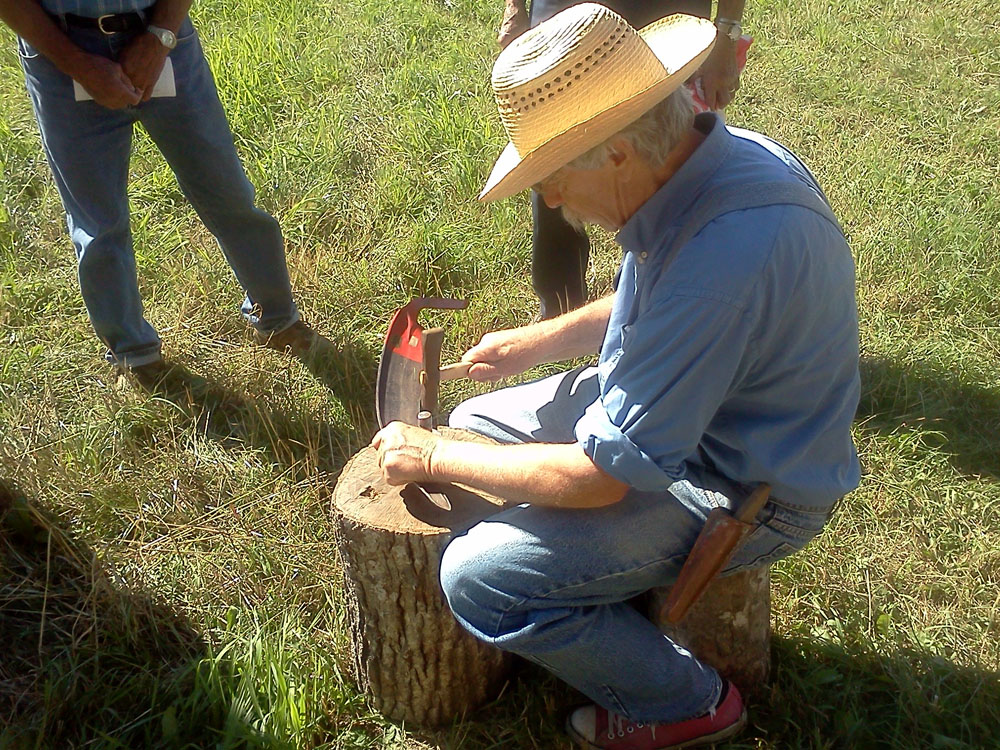
One of the reasons we wanted to immerse ourselves in all this scything expertise was to learn the arts of maintenance which, after all (and to paraphrase Isaac Asimov), is the foundation of eternity, at least where tools are concerned. Here’s Dirk van Loon teaching the dark arts of peening a scythe blade. I always say that if you come to learn, and you learn only one thing you didn’t know before, you’ve come to the right place. Yesterday we realized we’d come to the right place for more than a few reasons. (Mrs. LFM photo)

The novice category consisted of two competitors – the classically garbed Pitre sisters from Dartmouth, Rebecca (holding scythe) and Amanda (to the left of Rebecca partially hidden behind the woman with her back to the camera). (Mrs. LFM photo)
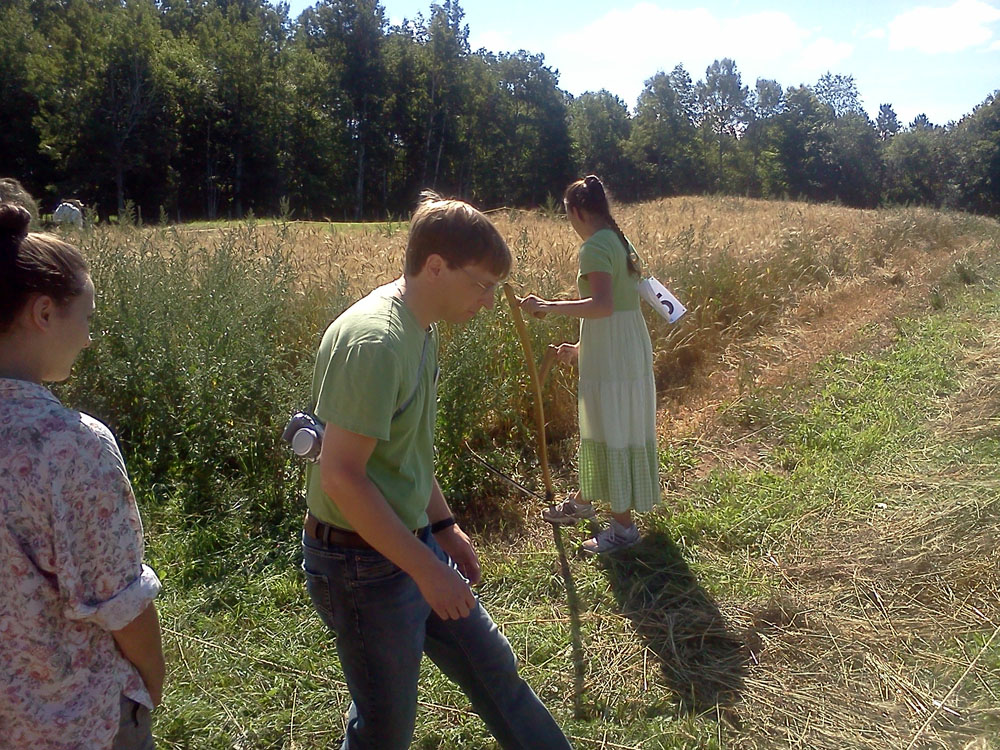
Rebecca Pitre steps up to the starting line to cut the first official competitive swath of the day. In the foreground is one of the judges whose name we didn’t get, but for today’s purposes and with all due respect, Bill Gates will suffice. (Mrs. LFM photo)

Aaaaand she’s OFF! As the video explains, scoring was based on three parameters – the width of the swath, the height of the stubble left after mowing, and the time to go the distance. (Mrs. LFM photo)
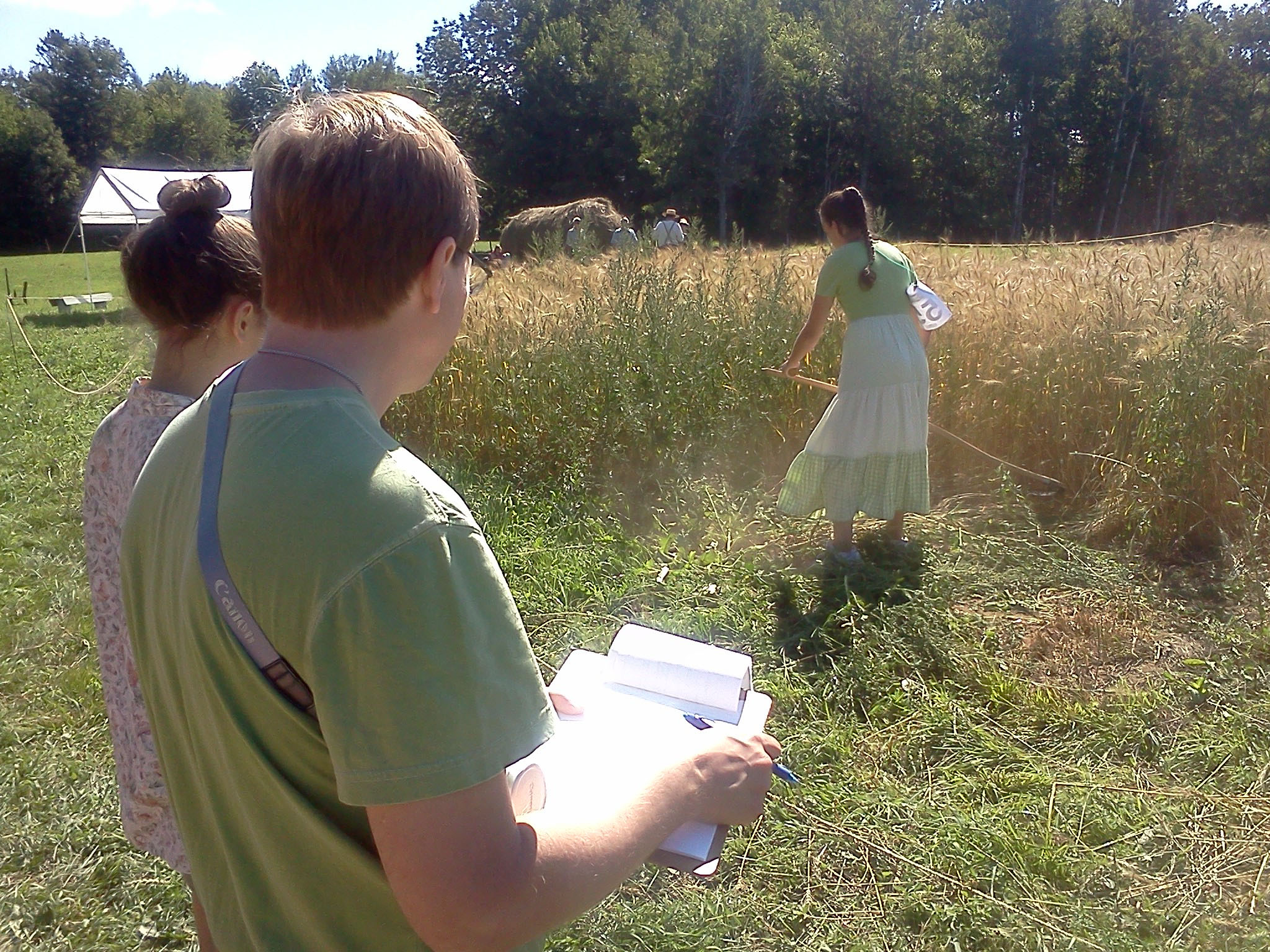
Well on her way, Rebecca is showing great form, and going strong for the finish line like a horse that’s smelling the barn. In a contest of sibling rivalry approaching epic proportions, Rebecca won the day over her sister Amanda, promising an exciting rematch next year. I’m not sure I’m man enough to go up against either of them, but I’ll give it a go. (Mrs. LFM photo)

Assembly begins for the open class competition. There were 18 competitors in the open class this year, and when all their scythes were hung on the rack behind the registration station, it looked like the parking lot out back of a bar frequented by Grim Reapers. (LFM photo)
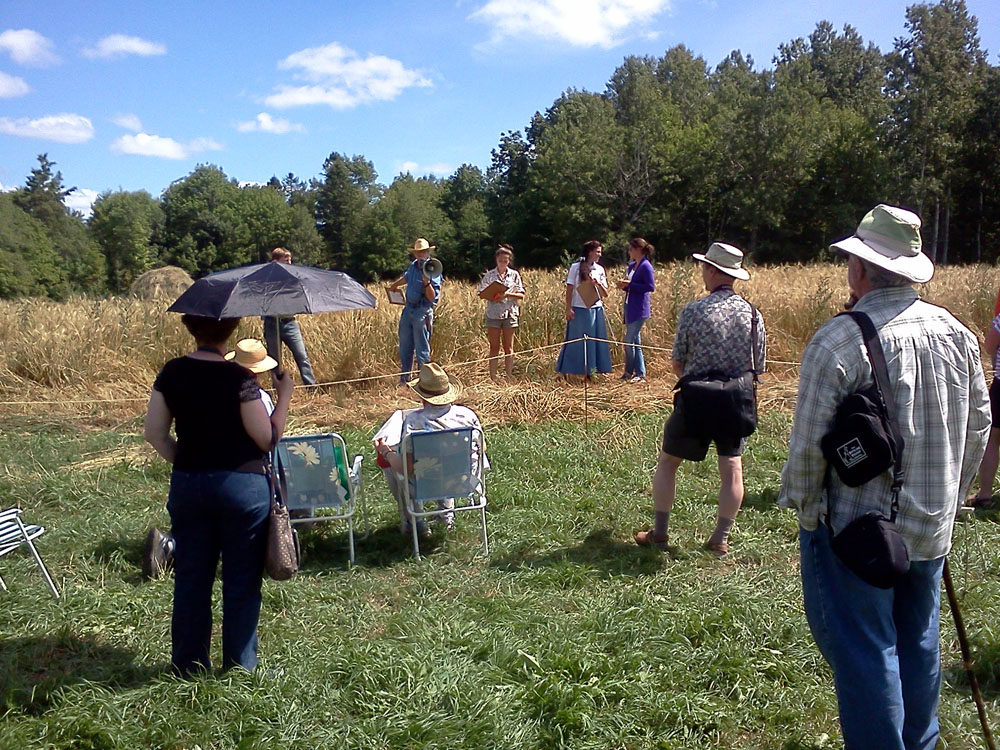
Dirk van Loon, flanked by the honourable panel of judges, calls the open class competition to order, lays down the rules of safety, and describes the scoring system. While this picture doesn’t show it, the field of spectators was extensive, and spanned ages from pre-school children to a gentleman of 101. (LFM photo)
Regrettably, other matters prevented us from viewing the entire slate of competitors on the day, and we’ll be announcing the winning lineup of the open category in a day or two.
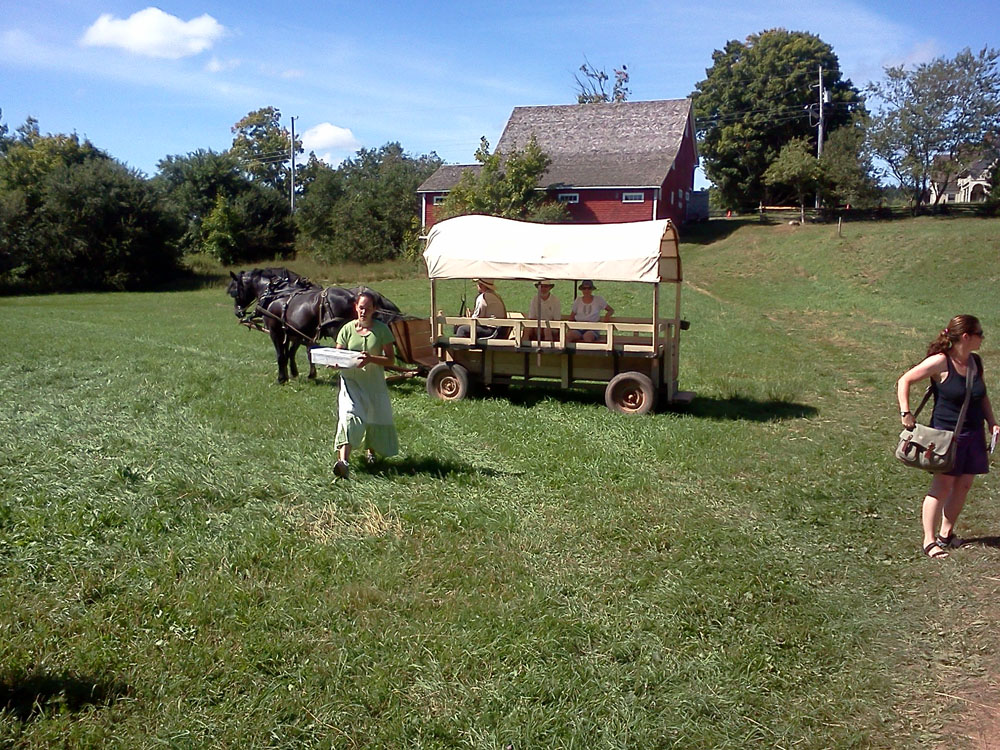
Ross Farm is a big place, and not everybody has it in them to walk the distance from the main entrance to the vicinity of the Cooperage and Blacksmith shops where the competition was held. And so, there was a highly fuel efficient bus service. (LFM photo)
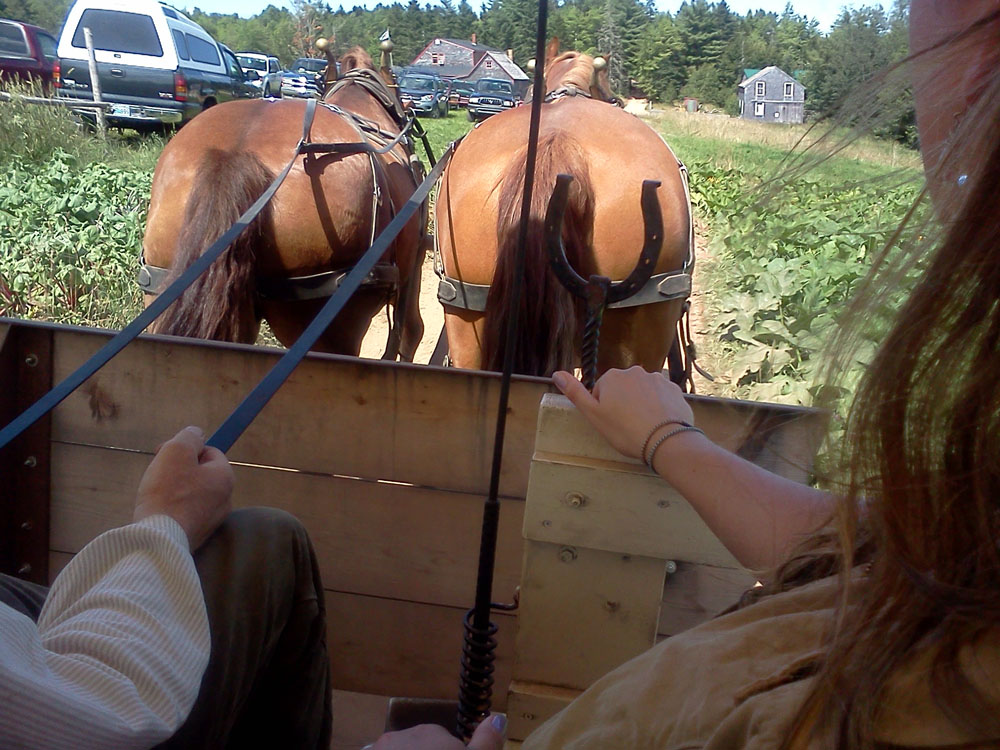
Mrs. LFM and I availed ourselves of it for the first leg of our departure. The two horsepower powerplant you see here consists of Sal (21) on the left and Ginger (15) on the right. The glimpse of Polish pulchritude on the extreme right is Mrs. LFM who, even as I thought it while shooting this picture, spoke the words, “Unless you’re the lead Dog, the view never changes.” (LFM photo)
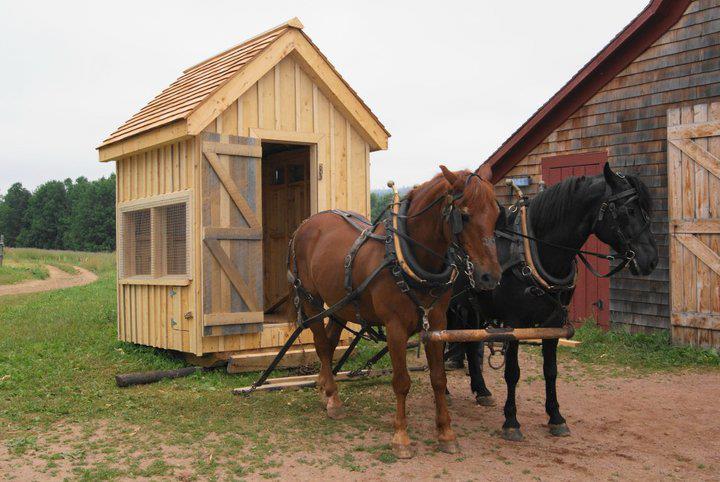
This image of Sal (left) and an unnamed coworker was posted by Ross Farm to their facebook page back on 16 August 2012 to commemorate Sal’s 21st birthday. Sal is short for Salazar – a sexy name if ever there was one – and that in turn is an abbreviation of his full birth name – Ross Farm Tain Salazar. (Ross Farm photo)
Sal was born at Ross Farm and has worked there ever since. He’s a Canadian Horse, as are all the rest of his equine coworkers, and that’s not just a statement of nationality. To quote an article by Robert Hirtle published on 5 June 2002 to the website southshorenow.ca under the title Ross Farm horses are truly Canadian –
They came from France’s royal stables in the late 1600s, part of five shipments of stallions and mares sent to what is now Quebec by King Louis XIV.
Their original purpose was to serve as a diversion for nobility in the new world, something to keep their minds off the harsh climate and the trials and tribulations of life in the remote colonies.
Their offspring evolved into what are known as Canadians, a breed of horses which descended from their Spanish Barb, Arab and Andalusian ancestors to become what Ross Farm Site manager Barry Hiltz calls “just a great horse.”
Their strength, willingness to work, and hardiness made the animals indispensable to the early farmers of New France, who also discovered that Canadians were just as adept at pulling a carriage as they were at pulling a plow.
By the year 1850, there were nearly 150,000 of them, spread out in all parts of the country. However, a disastrous attempt to improve the horses by cross-breeding in the 19th century severely depleted the unique stock.
Their versatility as both a pack animal, as well as a cavalry mount, made their use popular in both the American Civil War and later the Boer War, taking a further toll on their numbers.
By 1940, there were only 144 pure bred Canadians left in this country.
According to Rare Breeds Canada, that number had increased to only around 250 in 1990. That same year, Ross Farm’s board of directors instituted a unique project.
“We started on a heritage animal program, where we would have animals on site that would have been common to this area around 1870,” Mr. Hiltz said.
Part of that program involved the breeding of Canadian horses, and the museum was able to obtain three of the animals at that time.
Now, Ross Farm maintains the Canadian breed exclusively, and is one of a limited number of registered breeders of the animals in Canada.
The farm uses the horses in a variety of capacities.
Besides working them in the fields pulling plows and wagons, they are also saddled and ridden, hitched to sleighs in winter, and used as carriage horses during the summer tourist season.
Mr. Hiltz said a Canadian can maintain a 12-mile-per-hour gait while pulling a carriage without tiring.
Ross Farm is a member of the French Canadian Rare Breeds Program, and Sal was born shortly after they joined. Yet another shining example of what a valuable, everlastingly relevant, and decidedly non-anachronistic resource a place like Ross Farm is in a world that needs to take a bath in Reality.
Ross Farm Living History Museum, the Maritime Hand Mowing Championships, and every creature involved, regardless of leg count, bear the LFM seal of approval.
Many thanks for the coverage of this event that I never seem to get to.
Great stuff, Thanks Again
Thank you Earl, and you are very welcome. All things cooperating, Diana and I plan to compete next year so I’ll remind you when the time draws nigh.
Very cool. Bill Gates, hahahahahahaha.
I guess he’s livin’ the simpler life now. I hope you weren’t drinking anything when you read the caption to that picture.