The Skrælingibók
Posted By Randy on January 8, 2011
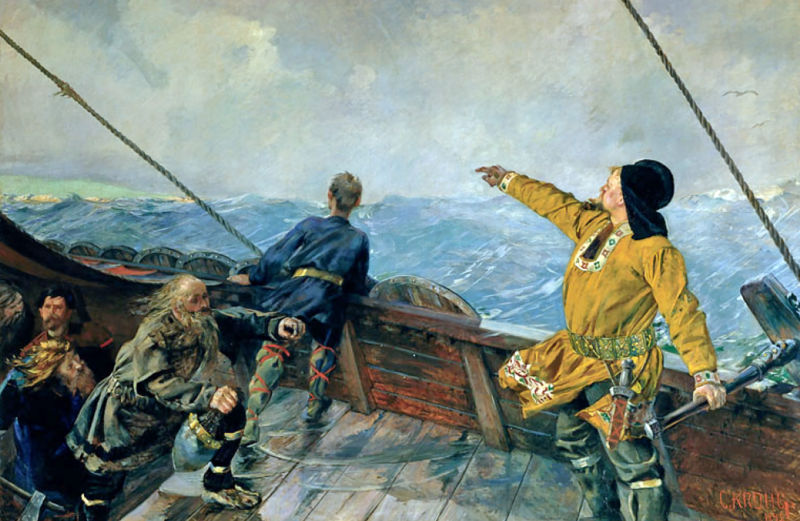
Leiv Eriksson oppdager Amerika (Leif Erikson discovers America) by Christian Krogh (1893). Click the picture for a larger version.
A thousand years ago, Viking expeditions out of Greenland made incursions into North America. Much of what we know of this time comes down to us from a pair of Icelandic Sagas that were written two hundred years after the events they describe, supplemented by archaeological examination of the failed Vinland settlement at L’Anse aux Meadows which is located on the extreme northern tip of the island we now call Newfoundland.
Grænlendinga Saga (The Saga of the Greenlanders) and Eiríks Saga Rauða (The Saga of Erik the Red) tell the story of Erik the Red’s banishment to Greenland, and his son Leif Ericson’s serendipitous discovery of Vinland. While both sagas contain elements of fancy and tend to mutually contradict one another, a thread of truth can nevertheless be disentangled, aided in no small part by the archaeological evidence. What has been, up until now, the subject of conjecture and controversy is why a people known for their fierceness and indomitable fighting spirit succeeded in the settlement of Greenland but failed so miserably in the far more benign land of plenty that was Vinland.
 We do know that the Norsemen built a small settlement at a place now called L’Anse aux Meadows, on the northernmost tip of present day Newfoundland, and used it as a base for further exploration of greater Vinland. We also know that there was ill will between the Vikings of that settlement and those they called the Skrælings, the Norse term for the incumbent inhabitants, that led to sporadic but escalating outbreaks of bloodshed.
This localized strife notwithstanding, archaeological evidence strongly suggests that Viking rovers traded with Skrælings as far south as modern day New Brunswick and westward up the St. Lawrence River. Contrary to popular belief, the fact that peaceful trading is more efficient, profitable, far less risky, and therefore much to be preferred over raiding and looting, was well understood by the Norsemen.
It has been not unreasonably theorized that the Skrælings with whom the Norsemen fought in Newfoundland were of the now extinct Beothuk people, but whoever they were, instead of peaceful commerce, only conflict characterizes Norse relations with them.
Why the Norsemen could trade successfully throughout the region, but so completely failed to live in peace at L’Anse aux Meadows that they were driven back to Greenland, was the subject of conjecture – until now. A recently unearthed and previously unknown Saga – the Skrælingibók (The Saga of a Skræling) casts a darker and completely unexpected shadow over why the embattled first – and last – Vinland settlement failed, and what was really at the root of conflict between the Norsemen and the Skrælings.
The Skrælingibók is the story of a Skræling woman, an exceptional woman described in the saga as a powerful shaman and a warrior of unbelievable skill. She is more importantly described as a hunter, but not one who hunts the things born of flesh. The Sagas have spoken of the lives and accomplishments of women before, but nothing ever found can prepare the reader for the contents of this singular document. Not only is its chronicling of the deeds of a non-Norse hero completely without precedent, but unlike the other Sagas written two centuries after the demise of the Vinland settlement, the Skrælingibók dates from a mere decade after the events it describes, implying its creation from tales told by the people who had actually lived the reality of of the last days of Vinland, and who were contemporaries of the writer.
The story is told of a terrible winter, of famine, and an even more horrific consequence than starvation visited upon Skræling and Viking alike. It tells of a community’s last hope in a losing battle with an evil as old as Man, an uneasy truce and a reluctant alliance born of necessity, and the spring of a desperate summoning. Of an autumn that sees the long awaited arrival of a hunter.
The Skrælingibók calls this hunter She Who Sees – but specifically tells us that her name is never spoken aloud. She Who Sees has come a great distance to hunt the thing that troubles the community, and that where all else has failed, she alone can be relied upon to succeed, for she has the power to see the Wendigo and bring it to ground. She alone fully understands her prey and its ravenous drive to find fresh meat. In the wake of successfully destroying its host, she patiently watches and waits as the Wendigo bides its own time before choosing anew, but this time among the Norsemen who now, predictably, blame the Skrælings for what has befallen them.
Facing yet another winter of mortal combat and primal fear, the Skrælingibók reveals the desperation of a Viking settlement that forces a decision to abandon Vinland, and a hunter’s determination to prevent the escape of her quarry.
______________________________
What you have just read is the introductory passage to a fictional account I am writing based on historical fact, educated conjecture, and a healthy dose of fun. I hope you enjoyed it and will spend your hard earned cash to purchase the fruits of this labour when it sees the full light of day. More information on Wendigo lore as it applies to my story can be found here.
Can’t wait for the book! 😉
Of course you can’t. You’re the Editor!
AND the template for the lead character … She Who Sees … Mmmmmm
Keep us posted as I want the book too ! Are you getting an advance ? You should. Need an agent ?
[…] the Wendigo what would be the point? If you don’t yet know the concept of the story, click here for […]
I think she who sees should be an older opinionated female who loves to drink mead…lol
[…] show back in 2008, the LFM readership has continued to grow each year, and 2011 was no different. The Skrælingibók – The Saga of a Skræling is moving ahead, and this year will see publication of three ebooks, all of which will be available […]