A Little More Trigger Time
Posted By Randy on August 24, 2012
Hard on the heels of yesterday’s LFM Range announcement, I’m taking it easy on you today by simply providing some outdoor eye candy and a review of the Webley & Scott Hurricane. British built Webley & Scott air pistols used to be imported into North America by Beeman Precision Arms, and could also be purchased directly from W & S in the UK. Cost new, when I first lusted for one over a decade ago, ran around $250.00 CAD in your hand, and that was a lot of coin as measured against more readily available, albeit pneumatic rather than spring piston, options like the Crosman 1377 and 1322 that at the time routinely gleamed on the shelves of your nearest Canadian Tire for far less than $100.00.
“Ah me,” thought I, “T’is simply not to be.” And so I shelved the idea indefinitely … until, as usual, the object of my desire came to me on its own – a repeating theme in my life.
Last summer, a client – a Scotsman if it matters – who resides seasonally in Nova Scotia called to have some work done, and in the course of my visit with him to size up the cost, he disclosed to me that he was in the process of lightening his load of booty. Among these items was an air pistol, and knowing my interests and background, he asked if I would be interested in buying it. Straight off I asked what make it was. When he said, “Webley & Scott”, like an Arabian diamond merchant I put my sunglasses back on and politely asked him to bring it forth for examination.
The item was the very weapon you see here, initially acquired from Beeman during his time working as an engineer working in Saudi Arabia for a UK company with interests there. He bought it for the twin pursuits of plinking, and for shooting the rats that made a habit of boldly going where he preferred no rat to go. In those roles it did yeoman service, and in the man’s retirement, had continued on until it was decided to move the piece along to a new custodian. That is how it is you know – any well crafted artifact is never actually owned – it simply passes into the keeping of a succession of people who are charged with its use and upkeep, or at least its preservation.
The pistol was presented. Placed into my hand and inspected. Only one small and purely cosmetic scuff marred the outer housing of its otherwise unblemished mechanisms. Test shots were fired, and I was glad of my sunglasses as I inquired as to price.
The number spoken being much to my liking, a deal was struck, and the pistol came home with me, much to the delight of Mrs. LFM who likewise enjoys tools of all persuasions.
The W & S Hurricane is no longer in print, although it can be found used, and its close relative, the Tempest, is still being made, in both .177 and .22 calibres. The primary difference between the Hurricane and the Tempest is the extended tang on the Hurricane that extends backward over the pistol’s grip, providing a longer sight radius as well as a handy spot to mount a long eye relief optical sight using the scope mount that comes with the pistol. Interestingly, in the days when both models were in production, only the extended tang furniture was made, with the extended tang ground off of those slated to be used on the Tempest series. There have always been some differences in the design of sights that were standard on both guns – the Hurricane sights have large knobs for adjustment of elevation and windage – those on the Tempest have always been lower profile. In all other respects, both guns are identical, and have a reputation for performance and robustness that is second to none.
I mentioned earlier a difference in operating mechanisms between the W&S Hurricane and the Crosman 1300 series pistols, and for those of you who aren’t educated in the field of air gunnery, I’ll pause now to briefly explain the difference. The Crosman 1300 series guns are prepared for firing by first repeatedly operating an underslung lever to pump air into a reservoir that runs beneath, and the full length of, the barrel. The pellet is inserted into the breech, and when the trigger is pressed the air in the reservoir is released to push the pellet out of the barrel. This offers a number of advantages for the operator who wishes to control the velocity of the fired projectile – fewer than the 10 maximum recommended will lessen muzzle velocity; but at the same time, ambient air temperature and solar heating of the reservoir can rapidly and radically increase or decrease the pressure levels of stored air, thereby affecting muzzle velocity and point of impact down range – higher pressure = raised POI, lower pressure = lower POI, as measured against POI established with a gun sighted in with shots fired immediately after each fresh recharge of the reservoir. In our own experiments we’ve found that while this will certainly affect shooters needful of pinpoint accuracy, it has little effect on practical shooting. Nevertheless, it is something to keep in mind when using a pneumatic air gun.
By comparison, a spring piston mechanism, as employed in the Hurricane and Tempest, consists of a powerful spring that drives a piston down the length of a cylinder, delivering a more or less predictable propellant volume every time the gun is fired. Cocking the action moves the piston of most spring piston air guns to the rear. Operation of the trigger simultaneously seals the cylinder and releases the piston to fly forward under the influence of the spring, compressing the air inside the cylinder and directing it into the breech end of the barrel where it then impinges on the pellet, sending it down range. The felt effect of this on the operator is a noticeable forward recoil induced in the gun at the moment the piston stops at the end of its forward travel Not so the W & S guns under discussion here because their pistons travel rearward, thus creating a felt recoil that is more in keeping with what is trained into those who operate powder activated firearms. In this respect I consider them to be excellent tools for maintaining the basic marksmanship skill set of proper weapon presentation, sight alignment, breath control, trigger squeeze, and follow through. All at the price of a fraction of a cent a shot, no deafening report, and no legal complications because, at a muzzle velocity of less than 500 fps, they do not fit the Canadian legal definition of firearms.
Using only the iron sights on the LFM Hurricane, I find that at 10 meters, the combination of overall weight, somewhat coarse work-a-day sights, not exactly glass smooth but still pretty damn good trigger, and the massive THUNK of the gun’s spring driven piston driving home as the pistol fires are all excellent stand ins for the LFM standard issue Browning High Power. Low recoil notwithstanding, all the elements are there.
Now, to the porn. Click what you like to make it bigger … nudge nudge, wink wink.
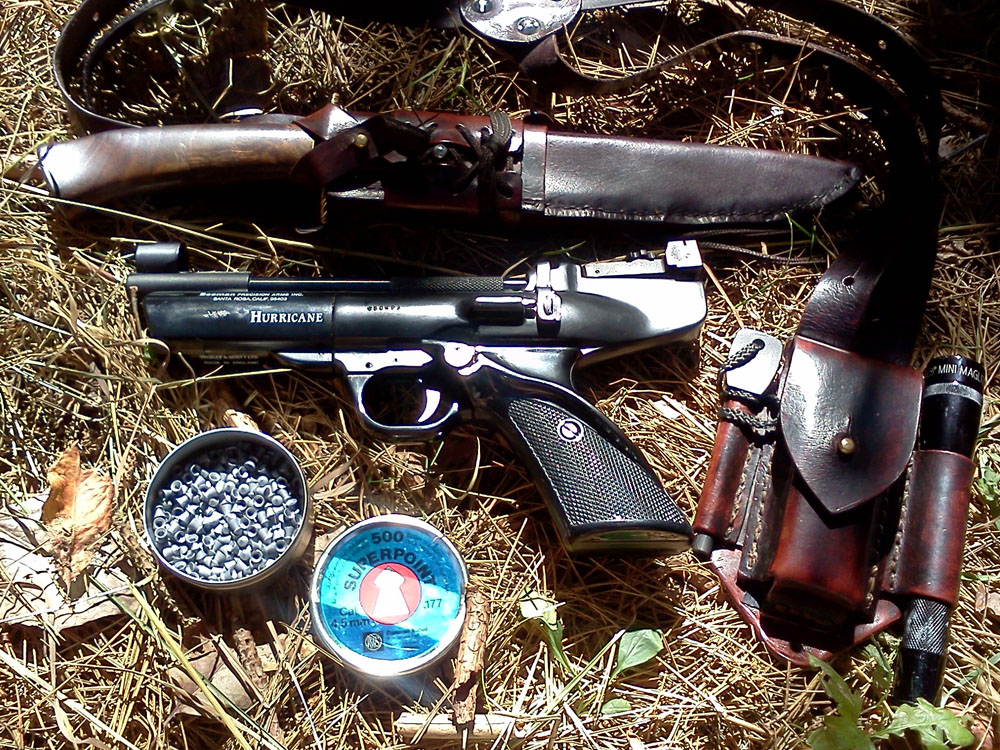
The LFM Hurricane posing with some of my standard field gear.
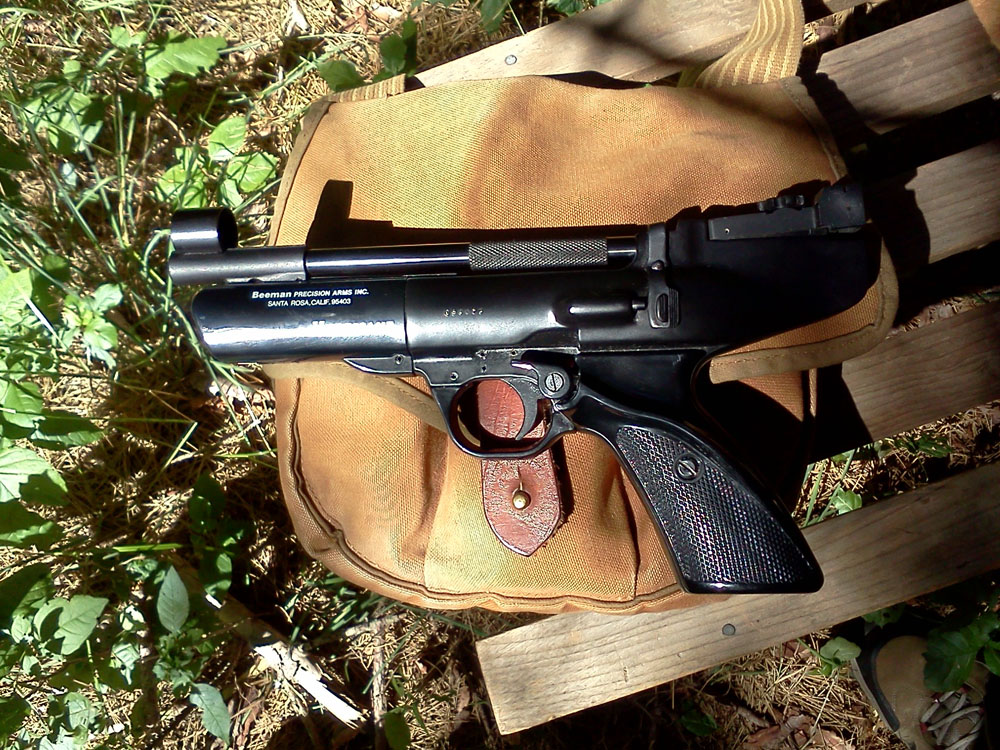
A closer shot of the Hurricane reclining atop my well travelled possibles bag that customarily contains a journal, writing instruments, a silicone gun and reel cloth, spare eye glasses, some teeny tiny binoculars, and spare ammunition for the catapult du jour, assuming there is one.
Comments
Leave a Reply