The Perfect Survival Knife
Posted By Randy on April 26, 2010
The generally held definition of a “survival knife” is a knife that is carried for the express purpose of facilitating the longevity of its owner in a situation wherein the shit has hit the fan. Internet forums on the subject abound with recommendations and equipment reviews, and I have my own opinions on the subject. Nevertheless, it cannot be denied that in its truest definition, the “perfect survival knife” is the knife you actually have in your possession, and are able to employ successfully, at the moment of your most dire need.
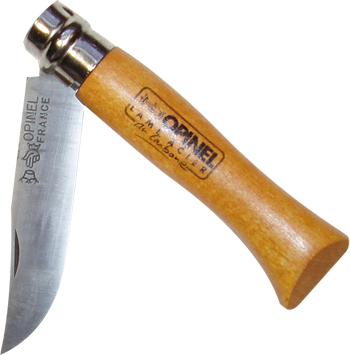 Case in point – the beautifully crafted Opinel knife. Opinel knives like the one pictured here are made in France to an ancient design. The handle is simple slotted wood without special liner or other embellishment. The locking mechanism is a very basic twist collar that does not self-activate like the folding knives most of us are used to, leaving it up to the user to decide when or if the blade needs to be locked open. Opinels have a reputation for swelling shut in damp conditions. They are criticized by some as structurally weak. I personally find them attractive, elegant, and effective in their intended realm of use, but they are certainly not the picture of the “perfect survival knife” as it floats in the mind of many a modern bushman … and yet I personally know of a group of men who are alive today because the Opinel carried by one of their number was there to be called upon to serve in the role of survival knife du jour. Only that knife in the hour of need and no other.
The men were crew members on the Cape Aspy, a scallop dragger out of Lunenburg, Nova Scotia that capsized and sank just after midnight more than 100 kilometers off shore on 30 January 1993. Our hero had just bought his Opinel a few days before, and had it in the pocket of his jeans. When the ship started to founder, the crew had very little time to get into their survival suits. On deck, they deployed the life raft that, after a struggle against strong winds to even get it over the side, successfully inflated and righted itself, and they all jumped into the black swells of the freezing Atlantic to board it.
Out of a crew of 16 souls, three were found dead while two more were declared missing and presumed dead. It is believed that neither of the latter two ever left the ship. Reports from survivors are that both were visible to them through the windows of the wheelhouse shortly before she went down, and neither man was wearing survival gear.
Those who made it into the raft now considered the fact that it was still tethered to the ship. They had been told that the tether would automatically tear away from the raft if the vessel went down, but at a time like that the mind wonders about the words of trainers who spoke them on dry land on a bright summer day.
As the ship began to heel, and with the tether line tightening with no sign of releasing on its own, my friend unzipped his survival suit and wormed his hand to the Opinel in his jeans. With his crewmates holding his legs while his off hand gripped the raft for dear life, he leaned out the boarding port, pulled the knife open with his teeth, and used it to cut the tether. Now, in an inflated raft that was bouncing like crazy, leaning arm extended over the dark ocean, he had to decide what to do next. Folding or bringing that blade back inside a crowded inflated raft wasn’t an option so, I am told with a pang of regret, he let it go. The knife gave its life to save its Master and his comrades. As good a knife story as I’ve ever been told.
That did more than pucker my butt!!!! I believe I puckered all over the place!
This is an almost identical story to that which happened to a great Ulsterman. Joey Dunlop. I cannot describe him to you, but we, in this wee country, are immensely proud, that he was one of our sons. Go to wikipedia to learn of him.
It is almost spooky when you hear this tale, that mirrors your friends. I hope you can understand our Scotch/Irish accents!
yours aye,
Griogairach
Hi Again, Sorry, Google the words Tornamona Sinking. It should get you the interviews with Joeys brother and friends regarding the sinking, and how a penknife saved them.
Hello Griogairach,
Thank you for the information. I will certainly pursue this tale!
Regards,
Randy
I happen to know personally that it wasnt “only” 2 men that died on the Cape Aspy but 5.
You are quite right GE, and thank you for your input. The portion that speaks to this has been corrected in the article.
In the wake of the tragedy, I was called upon to extensively debrief the person who wielded the knife in this case. He was immensely troubled by issues surrounding the two who remained aboard, and took a long time to come to terms with it.
To the families and friends of the other three men, I sincerely apologize. One of the greatest benefits of internet publication over print is that errors and omissions can be repaired without delay as soon as they are identified.
Thank you for reading, and thanks also for caring enough about the truth to bring this to my attention.
I believe that story to be BS , Of all the stories that came from the sinking I never ever heard that wise tale. Wondering if you could provide the name of the survivor who had the knife to truly authenticate the story as I am very curious as that particular boat I knew quite well.
A. Eisner
Thank you for your comment Ashley. I’m interested to know if you are a survivor of the Aspy tragedy.
The story as I have related it here was drawn from the testimony of a surviving crew member to whom I was related by marriage at the time the events occurred. Any more than that I am not prepared to say in answer to an open query, but it’s no secret so if you would like to send me a private message by way of our contact form, I will be happy to identify the gentleman in question.
In writing this article, the purpose of which was to highlight the importance of always having a sharp knife ready to hand, I was most interested in the Marine Investigation Report M93M4004 issued by the Transportation Safety Board (http://www.tsb.gc.ca/eng/rapports-reports/marine/1993/m93m4004/m93m4004.asp) which states, in part:
“1.13.5 Survival
“None of the crew members who boarded the liferaft knew of the position or use of the knife provided in the liferaft to cut the painter. However, the painter had been cut by the crew before the liferaft was washed over the side.”
This confirms that a member of the crew used a knife to cut the painter other than the one supplied for the purpose, but differs from the survivor anecdote only in the timing of the cutting. As an accident investigation, it would not need to delve further into the human details, the timing of which can be skewed in the minds of participants and observers who are actively fighting for their lives. Case in point, likewise from the TSB report:
“1.11.1 Difficulty in Launching Liferaft
“The liferafts were stowed in metal cradles on either side of the poop deck some 30 cm inboard of a 1 m-high shipside rail. They were secured in the cradles by means of nylon webbing secured to the deck by quick-release (senhouse) slips. They were not fitted, nor were they required to be fitted, with hydrostatic release systems (HRS). Thus, the starboard liferaft, which had become immersed in the sea due to the list, could not be reached and sank with the vessel.
“The liferaft on the port side was released by the crew. However, due to the list, the liferaft was effectively placed under the rail and this, together with its weight of about 170 kg and the motion of the vessel, made the liferaft very difficult to launch. Consequently, it was inflated on board and, as the inflation process commenced, the liferaft was washed clear of the vessel almost instantaneously.”
So returning to the story that was related to me and reported here, is it historically accurate to the final detail? Who knows except those that were there and may have registered what happened. According to the evidence though, I’d say it’s accurate enough to make my point, and that’s good enough for me.
I also remember what was said that the life raft was washed overboard due to the weather and swells . I remember being told a few could not make it to the raft in time , which were later plucked from the water perished . You need not tell me about a investigation report
Knowing that your father was lost with the vessel, I can understand your sensitivity to reading about this tragic event in any venue, but that doesn’t predispose me to offering bottomless forgiveness for your nasty attitude.
You clearly have your own version of the story in mind, and you’re sticking to it. You weren’t there when the Aspy sank, and neither was I, but I will stay with the official report whether you would like me to remind you of its existence or not.
I’m not sure where your reference to my article being, “… another case of someone inadvertently using someone elses misfortune for profit,” came from. If you actually read it, you’d know that I related the story that was relayed to me by an actual Aspy survivor, for the sole purpose of illustrating a point about knives. I did not profit in any way from writing the piece, nor do I have any financial interest in the Opinel knife company or any other enterprise that sells their wares.
You need to calm the hell down Ashley, and honour your father’s memory by showing some manners and tact. Your points have been made, as have mine. The article stands as written. Additional comments from you will be welcome, but only if they are offered in a more constructive tone, and free from any further reference to “wise” tales.
Again, never heard that wise tale and the skipper was my father so I know all the crew and lived this event very closely to the real story. And I believe this is another case of someone inadvertently using someone elses misfortune for profit. And your right who would know the difference of the truth to a good story from afar.
Wow, that is truly a survival knife. As a bit of a knife nut, I take pride in always having a good knife or two, always hoping that real survival will not be necessary.
[…] is an unbelievably hazardous endeavour, and I’ve written a bit about that previously in an earlier article. Even in this day of satellite navigation, emergency locator beacons, radar, fast all weather […]